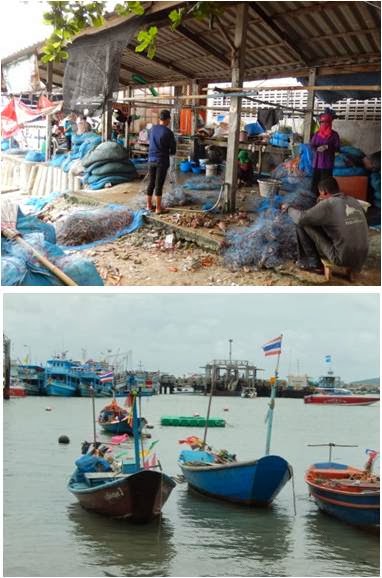
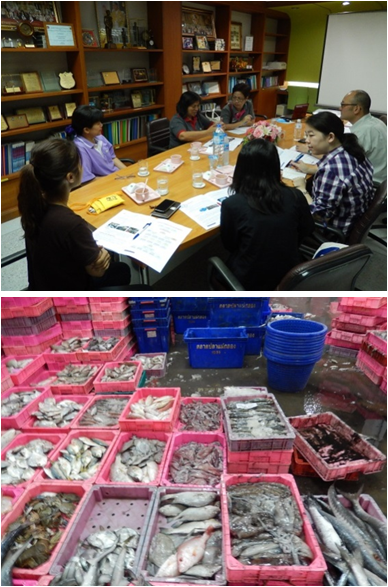
Report Trip for Household Survey at Rayong Province

Date: 16-20 September 2013

Objectives
1. To interview fisheries household at coastal small-scale fisheries
2. To discuss and get more information on situation of coastal small-scale fisheries after oil spill at Ko Samet

Results

16 September 2013
SEAFDEC team visited Mr. Jaii, one committee of Klang Municipal fishers group, to get more information on oil spill at Ko Samet.  Mr. Jaii and his friend mentioned on fisheries resources and payment reparation that the number of member is increasing from 63 to 75 after oil spill attached at Ko Samet on 27 July 2013 because small-scale fishermen need to get reparation (30,000 Baht per one fishing boat). Squid trap fishing gear must go to fishing farther than previous because old fishing ground did not meet soft cuttlefish, and the total catch is less. Now, the cost of fishing per trip is high but income is less, which compare with last year at the same time. In case of blue swimming crab fishing by bottom gill net, one member of group mentioned that the price of blue swimming crab is decreasing from 250 Baht to 100 Baht because nobody consumed crab from this area, they are worry on mercury from oil in sea food. Mr. Tid, group leader mentioned more on impact from oil spill that sardine is disappear from this area and he did not see fish school around Ko Kudi, where near Ko Samet.

17 September 2013
In the morning, social team visited Sala Keaw fishers group. Mr. Suwan, vice leader of Sala Keaw Fishers Group, gave information that number of member is 9 members. This group established at 40 years ago, with 30 members initiates. This group registered at last 3 years with Fisheries Provincial.  After group has been registration, Ban Phe municipal provided infrastructure of concrete floor and roof for group to packing fishing gear and activity operation including for landing site. The main fishing gear is crab gill net, and main species is blue swimming crab.  This group plan to establish crab bank activity, by requesting budget from government concern, because he and his member understand on rehabilitation fisheries resources and they believed that crab bank activity will be increased blue swimming crab. 
In the afternoon, social team visited Klang Sub-District Administrative Organization Fishers Group, which we have appointed group leader to interview yesterday. Mr. Bergreung, group leader, explained some information on group situation and some impact from oil spill. The main fishing gears of this group are squid trap, crab gill net and fish gill net. The number of member is increasing from 70 to 80, after oil spill.  This group is the first group of land site got reparation from Petroleum Authority of Thailand (PPT). He mentioned more that accident from oil spill made conflict in his group because some member agree to get reparation but some member did not agree.


 18 September 2013
In the morning, social team visited Nuan Trip Fishing port fishers group. Mr. Vichien Sirimaha, group leader, mentioned that the number of member is 11 remain, some member moved to other occupation and dead, no more new member in this group.  The main fishing gears are crab gill net, fish gill net and collapsible crab trap. There are 2 middlemen and 2 cages of crab bank in front of his group. 

In the afternoon, social team visited Kok Leam Tien fishers group. We met Mr. U-lay Sinsamut, group leader. This group registered with Fisheries Provincial at last year. There are 3 middlemen. Main fishing gears are crab gill net, fish gill net, fish trap and squid jigging. He mentioned on impact from oil spill that cost of fishing per trip is higher than last time because the fishing ground is too far. 

19 September 2013
In the morning, social team visited Kok Leam Tien fishers group to interview fishermen. The name of landing site of this group is Nai Kok. There are 3 fishers groups to packing fishing boat in monsoon season namely, Kok Leam Tien, Konh Aoa and Baan Hin Kaow. We met new fishers group, which Fisheries Provincial did not record this group in a list of Province. Therefore, the number of fishers group in Rayong is 28 groups. The location of Baan Hin Kaow fishers group is between Kok Leam Tien and Konh Aoa. Mr. Vichien Kongcharoen, group leader, said that there are 25 members, and number of member is increasing after oil spill. The main fishing gears are shrimp trammel net, crab gill net and hook. 

In the afternoon, social team visited Konh Aoa fishers group. Mr. Bumrung (Tid), group leader, said that the main fishing gears are crab gill net, fish gill net and hook. There are middlemen around 3-4 middlemen buy aquatic animal from this group. This group had been participated in Set-Net fishing gear with SEAFDEC initiate. He mentioned more on fishing boat registration that small-scale fishermen need good registration system and management by government supporting to the disaster.
20 September 2013
SEAFDEC/TD, RIHN by Dr. Kazuo Watanabe and KU by Dr. Methee Keawnern had a meeting and discussion on sharing information between component 4: Field survey for data and information collection of social and economic aspects. The main topic focused on the secondary data of fisheries community from government concern (such as local government, municipal, and Sub-District Administrative Organization). As well as there was an interview with head of village or Sub-District. The result of meeting need more information, which social team will be collecting more in the next survey of social survey in Rayong and Prachuap Kiri Khan Provinces.
  
Summary
The total samples of fisheries household of this trip is 43, composed of five fishers groups of 15 samples of Klang Sub-District Administrative Organization, 6 samples of Nuan Trip fishing port, 3 samples of Sala Keaw, 10 samples of Kok Leam Tien and 10 samples of Konh Aoa.

Impact of oil spill at Ko Samet by small-scale fishermen: Group leader and member of fishers group gave an information on situation of small-scale fisheries in Rayong after oil spill that
-          Fishermen, who get direct impact from oil spill, requested reparation from Petroleum Authority of Thailand 2,000 Baht per day for 2 months,
-          Need Petroleum Authority of Thailand/Government present the reparation to coastal community plan, if oil spill again in the future.

Information from Government concern on oil spill at Ko Samet: After oil spill on 27 July 2013 at Ko Samet, Phe Sub-District, Muang District, Rayong Province, Rayong Provincial Governor were coordinator between stakeholder along coastline of Rayong and Petroleum Authority of Thailand.  The stakeholder are fishermen (who have fishing boat), resort owner, tourist, restaurant and service (rental boat, rental car, etc).  There are about 10,000 persons of stakeholder, who applied attention to get reparation, and about 4,000 persons of that amount is boat’s owner.

On August, PPT gave the first payment of reparation to 2,000 fishermen (30,000 Baht per one fishing boat), who have fishing boat, but small-scale fisheries association of Rayong sent 4,000 fishermen to get reparation.  In the list of Fisheries Provincial have 2,000 fishing boat (commercial and small-scale fisheries). So PPT stopped to pay reparation, and need to verify on boat’s owner before payment.


Now there are problem between government and small-scale fishermen. Small-scale fishermen, who get direct impact from oil spill, need to register their boat with Fisheries Provincial to get reparation but they must be waiting for verifying by PPT before payment reparation. Meanwhile commercial fisheries, who not get direct impact but their boat have registration and license with Rayong Fisheries Provincial, get reparation already.

Report Trip for Household Survey at Pathew District, Chumphon Province

Date: 19-23 August 2013

Objectives
1. To study on fisheries management by coastal small-scale fishers group
2. To study the structure of fish distribution from fishermen to middleman

Results

19 August 2013
Social team left BKK for at Baan Koh Teap (village no.7), Pak Khlong Sub-District, Pathew District, Chumphon Province to observe on small-scale fisheries. The main fishing gears are collapsible crab trap and bottom gill net. The main species is blue swimming crab. This village is famous on crab bank activity, which is one fisheries management approach.  Crab bank system of this village is original to other coastal areas in Thailand, almost of gravid crab for crab bank donated by collapsible crab trap fishermen.

20 August 2013
In the morning, social team visited and reverenced head of Chumphon Fisheries Provincial, Mr. Somyos Sukcharoen. Social team explained the objectives of project and the survey. We got a lot of information on number of fishing boat, fishing gear, total catch of each fishing gear by logbook and type of fisheries management project, which DOF supported budget and material to coastal area at Pathew District. After discussion with Fisheries Provincial, we moved to Pak Khlong Sub-District, which we had appointment with Mr. Wara Ket-umpai, leader of Pak Khlong Fishers Group. Social team had interview the leader, 2 fishermen (group member), and 4 middlemen of Pak Khlong Sub-District. The main fishing gears are squid castnet and the main species is Splendid squid (loligo duvauceli).
 21 August 2013
In the morning, social team met Mr. Pisuthi Kuthpaksri, head of Pathew Fisheries Officer at Saphli Sub-District. He was counterpart with our team to visit representative of coastal small-scale fishers group of Saphli Sub-District. In addition, Mr. Narong had been leader of coastal small-scale fishers group of Saphi Sub-District but his group was collapsed at last 10 years because financial system is not transparency, one committee escaped with group’s capital. The social team interviewed 2 middlemen and 3 fishermen of Saphli Sub-District. The main fishing gear is bottom gill net, and main species is blue swimming crab. In the afternoon, social team visited Bang son and Chum Kho Sub-District with Mr. Pisuthi. The fishermen of two Sub-District are closely friend because they used the same cannel to packing fishing boat. This cannel is multipurpose for fishermen. It is for boat packing, transportation and fish cage culture. The main species of fish cage culture is sea bass. About 10 fishermen of Bang-son Sub- District have fish cage culture in this cannel. We interviewed one middleman from Chum Kho and 2 middlemen from Bang son.

22 August 2013
In the morning, SEAFDEC team visited Pak Khlong Sub-District, to interview more fishermen and middlemen. We have interviewed more 3 samples of fisheries management and 2 middlemen in village no. 3 and village no. 7 of Pak Khlong Sub-District.

For Fish distribution
1. Dry squid in Pak Khlong Sub-District;
The main species in Pak Khlong Sub-District is squid by squid castnet fishing gear. There are 5 small-middlemen in Pak Khlong Sub-District. They buy fresh squid and making dry squid and then sent product to big middleman in Pak Khlong Sub-District. There are 10-15 fishermen of squid castnet are under one small middleman. Every morning, small middleman would buy fresh squid from fishermen and make it dry about half day (depend on sun shine), this step small middleman would engage women in village for cutting squid and dry. The rate for cutting is 5 Baht per kg of fresh squid and rate for drying is 10 Baht per one basket. Then they would bring product to sale big middleman by size selection (10 sizes start from one inch to 10 inch) before sale but small middleman would buy fresh squid from fishermen only 3 size.

2. Mud crab in Saphli Sub-District;
Saphli Sub-District have a lot of mangrove forest and one main species of this area is mud crab. There are two middlemen in Saphli Sub-District, who buy mud crab from fishermen. After middlemen buy mud crab from fishermen, they will start by; 1) selecting the best crab of male and female. The best crab should be heavy weigh (if light crab, it will be culture to soft shell crab). 2) good crab will be separated to male and female, 3) male crab will be selected to 4 sizes, 200 g, 250 g, 300 g, and 350 g. 4) female crab will be selected to 4 sizes also, but the weight is difference by 300 g, 400 g, 450 g, and 500 g. 5) cutting rope from mud crab and release to each box and put in tank with sea water, this way will be removed mud from mud crab and make them to be stronger. Some mud crab will sell at front of middlemen house. Trader from local market will buy to sell at market.

Report Trip for Resources Management Survey at Klong Kone Sub-District, Samut Songkhram Province

Date: 13-16 August 2013

Regarding to SEAFDEC-RIHN project on "Coastal Area Capability Enhancement in Southeast Asian", social team plan to conduct social survey in 2013, which composed fisheries household survey, fish distribution of middleman and fisheries management approach in Rayong and Prachaup Kiri Khan Province. In fact, eco-tourism approach is one approach of fisheries management for coastal area in Thailand, and mangrove forest in Klong Kone Sub-District, Samut Songkhram Province is successful fisheries management by eco-tourism approach. SEAFDEC-RIHN Project plan to conduct eco-tourism in Klong Kone on 13-16 August 2013 including study the system and structure in wholesale fish market.

Objectives
1. Study on structure and process to establish eco-tourism.
2. Study on role of leader, member, governor and non-member (neighbor).
3. Study on principle system and structure of wholesale fish market in Thailand.

Results
 13 August 2013
SEAFDEC’s team, RIHN’s team and KU’s staff had a meeting at Thanicha Resort, Samut Songkhram Province, to discussion on survey plan and questionnaire design. Dr. Miyata has designed two draft questionnaires for leader of each activity and member of Klong Kone Mangrove Conservation Center (KKMCC). The result of meeting, the main questions of each questionnaire had improved and adjusted for more understanding, but the survey method was not clearing. We need to interview leader of KKMCC at tomorrow for more understand the structure and system management of eco-tourism, and who are responsibility on each activities, to be interview and planning the survey plan.

14 August 2013
In the morning, social team visited KKMCC to observe and interview leader and some heads of each activity.  In this day, KKMCC had one group visitor. After group tour went to operate activities at sea, our team started to interview Mr. Phenithi (Chet) Rattanapongthara, leader of KKMCC.


15 August 2013
In the morning, social team visited KKMCC again to interview head of each activity and some members.  There are five main groups activity  to operate eco-tourism in this center, which composed boat rental/mud-ski group, food service (restaurant) group, Mangrove reforestation group, Homestay group both in marine and inland.


16 August 2013
In the early morning, social team visited Maeklong Fisheries Cooperative, by walking around to see fish market activities, including interviewing and discussion with Ms. Boonsiri, manager of Maeklong Fisheries Cooperative, on history of establishment, and cooperative system.  After that, social team moved to Talay Thai Fish Market, Samut Sakorn Province. Mr. Sithavi Suwattanachai, manager of Talay Thai Fish Market, welcomed and gave a lot information on history and market system.

Training course on Practical Approach to Community-based Fisheries Management in Coastal Areas of Philippines

Date: 15-19 July 2013
Venue: Quezon Province, Philippines

Objectives:
1. To introduce the knowledge and experience on practical approach to community-based fisheries management to fisheries/field officers of Philippines,
2. To strengthen practical competence in planning and implementing the applicable coastal fishery management plans,
3. To enhance the HRD of fisheries officers to organized the community-based management with knowledge of community-based and rights-based fisheries management training course for local fishermen group.


SEAFDEC continue promote the community-based fisheries management in SEAFDEC's Member Countries. The Bureau of Fisheries and Aquatic Resources, Philippines also requested SEAFDEC to conduct an on-site training course on Practical Approach to Community-based Fisheries Management in Coastal Areas of Philippines particularly the coastal towns of Quezon Province bordering Tayabas Bay.
 
The training was attended by the representative from 1) Provincial Fisheries Officer of Quezon Province, 2) BFAR RFO IV - A Planning/Production/FRMD Officers, 3) BFAR Central Office Staff Coordinator/FRMD/Legal. The training was started by introduction of the status of community-based fisheries management of Region IV-A which was introduced by RD Esmeralda Manalang. After that, SEAFDEC staff gave an presentations on: 1. The importance of resource management for sustainable fisheries, 2. Appropriate Monitoring Control and Surveillance need for resource management in conjunction with community-based fisheries management, 3. Community-based fisheries management: Importance of autonomous fisheries management by community, 4. How to introduce and facilitate community-based fisheries management to fisheries community, 5. Rights-based fisheries management and support system (Extension work) by government, 6. Importance of fisheries data collection Information for sustainable fisheries management and concept and effective methodology on data collection, 7. Improving management of financial and economic activities including promotion of alternative livelihood in fishing communities, 8. Ecosystem approach to fisheries management.

After lecturing, The workshop on how to organize community-based management was conducted by divided into 3 session; session 1: Problems on the resource management through the application of the MCS of the Fisher Folk Association, session 2: Financial problems of the Association, session 3: Problems on the operation/implementation/functioning of Association and other matters that need to be strengthen.

In course evaluation, the resources person acknowledged the participants for their knowledge/skill as well as actively participation. The participants were very appreciated and thank to SEAFDEC for organizing this training course. Moreover, the participants also suggesstion that it should be include the topic on the status of coastal resource condition in Philippines as well as the training course on fiinancial management should be organized for the officers.

Training course on Facilitating Fisheries Information Gathering Through Introduction of Community-based Fisheries Management

Date: 13-16 May and 1-5 July 2013
Venue: Thanh Hoa province and Can Tho city, respectively

Objectives:
1. Support provinces under WB CRSD project with methodology to promote the applicable practice of community-based co-resource management.
2. Support establishing support officer system towards institutional building of stakeholders for coastal fisheries management through capacity building for fisheries extension activities.
3. Provide the practical tool and methodology of fisheries data collection and analysis in coastal small-scale fisheries for better development and management of coastal resources to ensure sustainable livelihood for coastal communities.
4. Provide toolkits with practical community-based co-resource management and data collection in the coastal communities for further training when developing 140 pilot demonstrations.


In 2012 SEAFDEC supported Vietnam with a very successful training course on  practical approach of community-based co-resource management for 16 officers. However with the number of 140 community-based management pilot sites expected to be established, Training To Trainers (TOT) courses aimed at providing more clear and detailed concept and methodology on community-based resource management, required tools to facilitating on community-based resource management such as tools of data and information collection in coastal fishing communities for better development and management of coastal resources to ensure sustainable livelihood of coastal communities, and skills of establishment and development of community fisheries development organizations are very extremely needed for Vietnam. Therefore, Vietnam proposed SEAFDEC to support Vietnam with 2 on-site training courses in 2013 on "Facilitating Fisheries Information Gathering Through Introduction of Community-based Fisheries Management". The first one was conducted in Thanh Hoa province from 13-16 May 2013 for key provincial staff who are directly involve in co-management implementation and key leaders in selected sites in Northern Provinces including Thanh Hoa, Nghe An an Ha Tinh. The second TOT training course was conducted for key persons Southern Provinces including Soc Trang and Ca Mau with the information from 1-5 July 2013 in Can Tho city of Vietnam. 

The training was started by SEAFDEC's presentations: 1. The importance of resource management for sustainable fisheries, 2. Appropriate Monitoring Control and Surveillance need for resource management in conjunction with community-based fisheries management, 3. Community-based fisheries management: Importance of autonomous fisheries management by community, 4. How to introduce and facilitate community-based fisheries management to fisheries community,  5. Rights-based fisheries management and support system (Extension work) by government, 6. Concept and effective Methodology on Data Collection, 7. Data collection through CBFM, 8. Improving management of financial and economic activities including promotion of alternative livelihood in fishing communities, 9. Ecosystem approach to fisheries management, 10) Case study on community-based management in Nam Haum reservoir.

In addition, the training also conducted the workshop on how to organize community-based management in each province through reviewing difficulty and find the way go forward by divided into 4 session; session 1: Set up team to facilitate CBFM and Conduct pre survey of community, session 2: Education for Community Fisher, session 3: Organize core person meeting, session 4: Establish Community Fisheries Management organization.

In course evaluation, the resources person acknowledged the participants for their knowledge/skill as well as actively participation. The participants were very appreciated and thank to SEAFDEC for organizing this training course. Moreover, the participants also suggessted that it should included the topic on the status of coastal resource condition in Philippines as well as the training course on fiinancial management should be organized for the officers.

Report Trip for fisheries household survey at Prachuap Kiri Khan Province

Date: 24-28 June 2013

Objectives
1. To discuss and get more information on situation of coastal small-scale fisheries
2. To study on fisher group establishment and fisheries management activity
3. To interview fisheries household at coastal small-scale fisheries
4. To pre-test fish distribution questionnaire by middleman

Results
 25 June 2013
SEAFDEC team discussed with CMDEC’s team on number of samples and survey plan of this trip. In the morning, social team visited Baan Pakklong Bang Sapannoi village to collect 11 samples, as well as discuss with fishers on group establishment and fisheries management. The main fishing gear of this group is anchovy castnet and squid trap, and main species are anchovy and soft cuttlefish. In the afternoon, we collected data at Baan Fung Dang village. The main fishing gear is bottom gill net, and the main specie is blue swimming crab. After that, we moved to Baan Chai Tale. The main fishing gear is anchovy castnet, and the main specie is anchovy.

26 June 2013
In the morning, social team divided into two teams, the first team collected data at Baan Pakklong Bang Sapannoi fishers group with 5 samples, and one middleman of soft cuttlefish. The second team collected data at Baan Fung Dang fishers group with 7 samples. In the afternoon, social team went to Baan Chai Tale fishers group to collect the data with 6 samples, and interview one company, which buy soft cuttlefish and dry anchovy in Baan Pakklong Bang Sapannoi village.

27 June 2013
In the morning, SEAFDEC team visited Baan Nong Samed fishers group to observe middleman for interviewing, the main specie is blue swimming crab and shrimp. We interviewed one middleman and one collector at. SEAFDEC team visited and interview one company, which buy dry anchovy in Baan Pakklong Bang Sapannoi and Baan Chai Tale village.

Summary
The total sample of this trip is 37 samples, from three fishers groups namely, Baan Pakklong Bang Sapannoi, Baan Fung Dang and Baan Chai Tale. From two surveys in 2013, we have finished 72 samples collected of Bang Sapannoi District.

In addition, Baan Pakklong Bang Sapnnoi fishers group, which is a big group, has members around 100 members. There are a lot of fishing gears in this group such as anchovy purse seine, anchovy castnet, bottom gill net, shrimp trammel net, squid trap and driving of sea urchin and clam. Now, this group has conflict among fishing gear, some small-scale fishermen complained anchovy castnet, because this fishing gear catch a lot of small fish such as small mackerel. According to this conflict, fishermen in this area have formed a new fishers group namely “Underwater resources (coral reef) conservation group of Baan Pakklong Bang Ssapannoi village” in 2011. There are 80 members, which compose of fishermen and owner of tourist boat. The objectives of this group are protecting coral reef and collection garbage underwater and beach.

For fish distribution, two middlemen and two companies were interviewed in this trip, one middleman buy soft cuttlefish, and another one middleman buy shrimp, blue swimming crab, squid and fish. One company buy soft cuttlefish and dry anchovy, and another one company buy only dry anchovy. At Baan Pakklong Bang Sapannoi village, middlemen have four fishermen. The middlemen sell to tourist and cold storage. The cold storage would buy soft cuttlefish 50-1000 kg per day from 3 big collectors and 2 small collectors. Soft cuttlefish frozen will be sent to main cold storage at Rayong Province, which export to Taiwan. In case of dry anchovy production, the cold storage company will buy from fishermen directly. The main market of this company is Malaysia.

For the structure of middleman at Baan Nong Samed fishers group, the middleman purchase products from two fishers groups namely, Baan Nong Samed and Baan Pakklong Bang Sapannoi village. Baan Nong Samed has one collector, who collected products from 30 fishermen and send to middleman. The middleman will sent all product to Talay-Thai Fish Market, Samut Sakorn day by day.

Report Trip for fisheries household survey at Rayong Province

Date: 10-14 June 2013

Objectives
1. To discuss and get more information on situation of coastal small-scale fisheries
2. To study on fisher group establishment and fisheries management activity
3. To interview fisheries household at coastal small-scale fisheries
4. To pre-test fish distribution questionnaire by middleman

Results
10 June 2013
SEAFDEC team met Director of EMDEC and informed her the objective of this trip and requested two staffs to collaborate with SEAFDEC’s staffs on the surveying. After that, social team went to each fishers group to make an appointment with leaders of fishers group of Ao Charoen fishers group, Wang Kaew fishers group, Klang Municipal fishers group and Ao Makham Pom fishers group. Our appointment was including the interviewing each leader of Fishers group on establishment fishers group, what kind of resources management activity which implement in their communities, fisheries problems, benefits from fishers group establishment and fish distribution.

11 June 2013
In the morning, social team visited Ao Makham Pom Fishers group to collect 8 samples, including interview one middleman, the main specie of this fishers group is blue swimming crab. In the afternoon, we collected data at Klang Municipal fishers group, with 11 samples, the total number of this group is 16 samples. The main specie of this group is soft cuttlefish.

12 June 2013
In the morning, social team divided into two teams to collect the data at Wang Kaew fishers group
with 7 samples, and Ao Charoen fishers group with 4 samples. In the afternoon, social team went to Klang Municipal fishers group to collect 5 samples, including interviewing one middleman, who bough soft cuttlefish.

13 June 2013
In the morning, SEAFDEC team visited Ao Makham Pom fishers group to interview 2 middlemen of blue swimming crab. In the afternoon, SEAFDEC team visited Klang Municipal fishers group to interview one company, which is the middleman who buy soft cuttlefish.

14 June 2013
SEAFDEC and EMDEC participated in the meeting of set net group meeting, the objective of this meeting was changing capital to share for all members (including former members).

Summary

The total samples of this trip are 35 samples in four fishers groups, the number of sample was calculated by extraction method. In addition, the total of small-scale fishers group in Rayong Province is 27 groups. The total of small-scale fishing boat is 1,312 fishing boats. The main aquatic animal is blue swimming crab and soft cuttlefish. There are two main activities for coastal resources rehabilitation. The first activity is crab bank activity and the second activity is FEDs (Fish Enhance Devices), which implemented at coastal area in each fishers group.


The middlemen at Ao Makham Pom Fishers group buy blue swimming crab from bottom gill net and collapsible crab trap. Blue swimming crab from bottom gill net will be landed in the morning. Middleman will buy live blue swimming crab directly from fishers and then sell to retailer and restaurant. For non-living crab, the middleman will sell to factory. For blue swimming crab from collapsible crab trap, it will be landed whole day. The middleman will buy and sent to retailer/restaurant/tourist and also to factory. In case of soft cuttlefish at Klang Municipal Fishers group, the middlemen buy fresh soft cuttlefish and send to restaurant/retailer and also export to Taiwan. 

Regional Workshop on Promotion of Alternative Livelihoods Business through the Establishment of Autonomous Fisheries Community-based Resource Co-management System


Date: 25-27 March 2013
Venue: Bangkok, Thailand

Objective:

1. Lesson-learned the alternative livelihood business creation through autonomous community-based resource management systems;
2. To find out the key factor and the successful way of the effectiveness of financial and economic business operation in fishing community.

Background of the Regional Workshop

Establishment of the system of Autonomous Community-based Resource Management (ACBRM) is also useful to improve local livelihoods and alleviate poverty in fishing communities through finding the way of alternative livelihoods business, financial and economic activities such as micro-finance system, bulk purchase and auction system. Therefore, the Regional Workshop was organized to improve the knowledge of ASEAN fisheries officers for the concepts, principles and practice of promotion of alternative livelihoods business and financial and economic activities for alleviation poverty, and its additional function in autonomous community-based resource management.

Conclusion of the Regional Workshop


The SEAFDEC Member Countries presented their activities concerned alternative livelihoods business through fisheries community-based resource management. Besides, the role and future plan for promoting alternative livelihoods business, financial and economic activities also was clarified in the meeting. Moreover, the resource persons presented on the lesson-learned and experiences related to alternative livelihoods and promoting micro-finance services and activities. The lesson-learns were emphasized in various projects such as Integrated Coastal Resources Management in Pathew District project, Thailand (ICRM-PD) and Sihanoukville, Cambodia (ICRM-SV), as well as the Regional Fisheries Livelihoods Programme for South and Southeast Asia (RFLP). Furthermore, the Regional Workshop found out the key factors of success of alternative livelihoods business including the way forward for promoting of alternative livelihoods and the financial and economic creation. The key factors that lead to successful alternative livelihood initiatives are divided into 11 factors;
1) Cohesiveness at work,
·         fostering a spirit of working together or camaraderie.
·         Motivating the spirit of community solidarity.

2) Sustainability,
·         Shifting of project operational obligations to be defined during planning.
·         Ensuring that business or alternative livelihood initiatives can be handled by communities.

3) planning,
·         Minimizing too ambitious and unrealistic original plans in many cases.
·         Participatory planning with communities must be observed.

4) Selection of target business or livelihood alternatives,
·         Determining the readiness of stakeholders to undertake a new challenge.
·         Considering the unique characteristic of communities in planning livelihood alternatives.
·         Evaluating market demand for alternative livelihood products.
·         Considering the risks of undertaking new business options comprising technically unknown factors.

5) Accounting and bookkeeping,
·         Establishing transparency in handling money.
·         Improving financial management capacity of concerned stakeholders.
·         Maintaining accurate records of raw materials, production, sales, etc.

6) Initial funds,
·         Creating initial fund (seed money) to start new livelihood initiatives.
·         Obtaining government or donors support which is necessary to create initial fund.

7) Revolving funds and micro-credit scheme,
·          Establishing an internal micro-credit facility or community savings scheme for small scale initiatives might be a practical option.
·         Maintaining revolving funds.

8) Government support,
·         Fostering government’s ability to provide technical and financial support when required.

9) Institutional support,
·         Ensuring that all local livelihoods or business initiatives take place under the umbrella of local institutions, e.g. fisheries cooperatives.

10) Leadership,
·         Having dynamic and competent leadership of the group is essential.
·         Having smart officers and smart fishers (experienced and knowledgeable, skillful, good attitude, practicing good governance, strongly committed) is necessary.

11) Fisheries management organizations.
·         Establishing fisheries co-management organizations such as fisheries cooperatives as basis for developing livelihood initiatives/alternatives.

Moreover, the recommendations was clarified from the participants such as 1) Conducting local training programs to start livelihood alternatives, 2) Dissemination of the livelihood programs to village levels, 3) Development of small and medium enterprises (SMEs) for fisheries products.

Social survey to Rayong and Prachuap Khiri Khan Province under SEAFDEC-RIHN Project


Date: 18-22 February 2013
Venue: Rayong and Prachuap Khiri Khan Province

Objectives:

1. To make clear and get more information on location of coastal small-scale fisher groups with Fisheries Provincial officers.
2. To visit and interview leader of fisher’s group at coastal area of target site in Rayong and Prachuap Khiri Khan Province.
3. To collect the data by interviewing fishers at coastal area of target site in Rayong and Prachuap Khiri Khan Province.

Result

The SEAFDEC-RIHN project, Component 4: Field survey for data and information collection of social and economic aspects, plan to collect the data two times in year 2013. The first survey on 18-22 February 2013 by dividing two teams for two sites (Rayong and Prachuap Khiri Khan Province). The interviewers of each site composed of three counterparts from RIHN, SEAFDEC and DOF, Thailand.

In Rayong Province, the sample size was estimated by extraction method that used the total number of fishers in target area around 1,312 fishers for calculation. The total extraction number of the survey is 297 samples including 27 fishers' groups. The SEAFDEC-RIHN and DOF staff collected the data by interviewing the fishers in two fisher's groups in Rayong Province. The samples at Rua Rop Ruan Prasae Fishers’ group was 11 samples, the main fishing gear was fish gill net. The samples at Nern Khor Fishers’ group was 25 samples,  which the total sample was 35 samples. The main fishing gear was swimming crab gill net.


In Prachuap Khiri Khan Province, the total number of fishers in target area around 953 fishers. The total extraction number of the survey is 274 samples including 9 villages. At this time, the interviewer was collect the data in 4 fishers' groups, Ban Nongsamed (11 samples), Ban Khaek (12 samples), Ban Bangberd (11 samples), and Ban Pakklongbangsaphannoi (1 sample), the total sample was 35 samples.


All of the data of Rayong and Prachuap Khiri Khan will be input to excel program and sent to RIHN team at Japan for data analyzing. The second data collection will be held in the mid of year 2013 in the same provinces but different fishers' groups.