
Date: 15-17 June 2016
Venue: Da Nang
City, Viet Nam
Objectives
1. Support
key staff at provincial level and key persons in the co-management
communities with the knowledge of utilization data to formulate the fisheries
resources management plan and implementation.
2. Introduce the extension strategy and components
to promote co-management in Vietnam.
Result
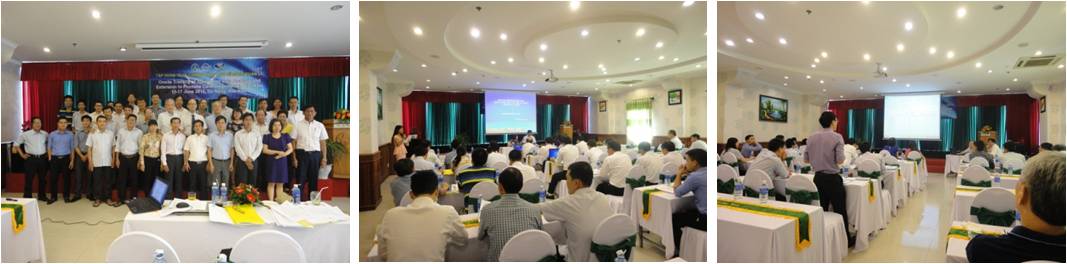
The Training had 3 sessions;
session 1. Data
collection reporting and analysis, session 2. Utilization
collected data for formulation of fisheries resources management plan, and session 3. Practical activity:
develop the result to be fisheries management work plan and how to promoted.
The session 1 had
five presentations from resource person from Vietnam, Japan (Dr. Tsutom
Miyata, the Head of Fisheries Socioeconomics
of Japan Fisheries Research and Education Agency, and Mr. Hidenao Watanage)
and SEAFDEC (Ms. Thanyalak Suasi, Socioeconomic Scientist). The presentation
focus on the overview of data collection in Viet Nam as well as how to collect
and analyst the data including reporting the result of data analysis.
The session 2 composed of five
presentations focusing on how to develop the fisheries management plan
including the case studies from Japan, Thailand, and the Philippines. It is
important to conduct principal/basic survey to get the information for
Fisheries Management Plan (FMP). As well as the participation from the fishers
is very useful for the data collection and FMP, therefore, it need to encourage
and involve the fishers in the process of planning. Moreover, the presentation also
clarified more on the supporting from the
government which is essential to organize and keep the co-management and CBFM.
The government must protect and sustain local fisher's decision and activities
for fisheries management by legal framework by giving them the fishery right to
protect and sustain CBFM.
The session 3 was the practical activity: develop the result to be
fisheries management work plan and how to promoted by using law data of Viet Nam.
Before start the session, Dr. Yasuhisa Kato, Chief Technical Advisor (CTA) for
the Coastal Resource for Sustainable Development Project (CRSD) in Viet Nam,
suggested that the officers should understand on the importance of data
collection and convince the fishers to collect the data by themselves. Then,
Dr. Long kindly presented on the data of Camoa Province. He introduced the CPUE
in each month from commune data collected. After that, Dr. Yuttana, who was a
chairperson in this session, invited each province to introduce the data and
difficulties in order to collect the data. The difficulties were 1) lack of resource
person to collect data, 2) the collector have not been trained so they do not
collect the data well, 3) fishers use many kind of fishing gears, therefore, it's
difficult to identify what each species came from which fishing gear.
After
presented all data from the Province, the resources persons kindly gave them
the suggestions. The fisheries data should be included the production form
illegal fishing gear too even it difficult to get the data. Moreover, if the
fishers are very poor, it difficult to change the fishing gear, therefore, the
government should support the fishers in order to change the fishing gear. In
addition, the participants were very interested on the demarcated community
fishing area in Japan. It would very useful, if it can be applied to suit with
the Viet Nam condition.


