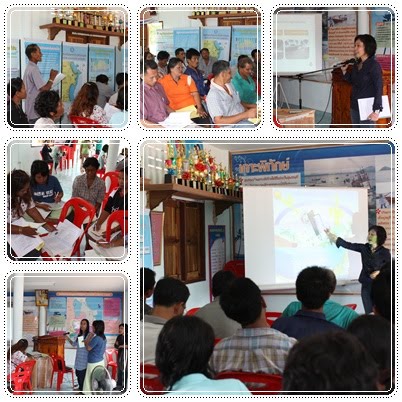
The third on-site workshop on local users' participation for managing environment friendly to sustainable fisheries

Date: 6-8 July 2010
Venue:
Ban Thongkrog Village, Bangnamjeud Sub-district, Langsuan District, Chumphon Province

Objective of the workshop:

1. To promote local fishers and residence to recognize an importance of environment friendly to sustainable fisheries.

2. To build up and strengthen local people’s awareness on responsible fisheries resource utilization friendly to environment.

3. To promote local fishers and residence participated in sustainable fisheries management.


Activity implementation:

The third on-site training was the last training which focuses on the environment in the community and environment’s problems through the way to solve those problems. Dr. Phattareeya S. was kindly presented on the environment and management in the community. In addition, the problems found in the community were garbage elimination and waste water drainage, and lack of awareness of local uses which this problem effect to community marine environment. Moreover, the audiences are recommended another problem that is inadequate of the garbage management system. They said that it should have campaign and educational of garbage management.

The audiences were divided into three groups and discuss on the method to solve the problems which was; 1. Stop burning and make organic fertilizer, 2. Garbage separation and garbage bank, 3. Building awareness on economically using water. The audiences needed to analysis the strength and weakness on their respective topic. After that, the representative of each group was request to present their result. The result of the evaluation show that the audiences satisfied on this workshop. Moreover, they recommend that the workshop should be organized in the afternoon because some audiences need to work in the morning.

The second on-site workshop Integration of community for managing environment friendly to sustainable fisheries

Date: 8-10 June 2010
Venue: Ban Thongkrog Village, Bangnamjeud Sub-district, Langsuan District, Chumphon Province

Objective of the workshop:
1. To promote local fishers and residence to recognize an importance of environment friendly to sustainable fisheries.
2. To build up and strengthen local people’s awareness on responsible fisheries resource utilization friendly to environment.
3. To promote local fishers and residence participated in sustainable fisheries management.


Activity implementation:
The second on-site training was continually delivered an impact of green house effect to community ecological marine environment in accordance with local people practiced on daily garbage elimination and waste water drainage. The presentation repeatedly explained the rationale of environment management in the community. The green house effect and climate change was clarified its impact to other community and the world. To alleviate a violence of the impact to the community, the presentation was introduced an integrated practice to reduce the impact of green house effect as fig1.

Fig. 1 Integrated management for environment friendly to sustainable fisheries

Three main practices were suggested such as reducing of methane gas by making organic fertilizer from food and vegetable as daily garbage from a household; reducing carbon dioxide from stopped burning garbage, recycle trash and conducting garbage bank in the community; and reducing waste water drained directly to the ground and wisely and economically use water. These practices were emphasized based on local people practice and experience. After delivered the presentation, fifteen audiences divided into two groups to discuss on two topics;

1. How do you hand and participate in managing environment in your community? and
2. In the next five years, how will environment in your community be?

To evaluate how far audiences understood the workshop, the workshop evaluation form was distributed to the audiences to fill out the form. There were twenty audience responded the form. The report of the evaluation would merely focus on what the audiences gained and their suggestion and recommendation should be done for improving environment in their community.

Gained knowledge:
1. Understand right methods of preventing, solving and management environment
2. Understand an importance of garbage management and elimination, recycle and garbage bank management
3. Better understand the impact of green house effect and climate change
4. Acknowledge on making organic fertilizer from left food and waste water management
5. Receive an useful information apply for their genuine practice
6. Increase local people awareness

Suggestion and Recommendation:
1. Should continually organize the workshop to build up awareness of local residences.
2. Should have variety of training methods included expanded duration of training
3. Should provide picture concerned the impact for trainingThe organizer should inform the community earlier in order to have massive residence’s participation in the workshop.

The training course on freshwater fish cage culture (Tilapia, Common silver barb and frog) for local fisherfolk in Nam Ngum Reservoir, Lao PDR

Date: 24-29 May 2010
Venue: Udonthani Inland Fisheries Research and Development Center, Udonthani Province, Thailand

Objectives of the workshop:
To strengthen fishing community organizations and institutions to enable them to take leading role in practicing rights-based fisheries and co-management for inland fisheries management; and to establish fish conservation zone through co-management at Nam Ngum Reservoir.
Activities

Activity implementation:
Sixteen local fisherfolk from around Nam Ngum Reservoir in Lao PDR, coming from four villages, provincial and district fisheries offices participated in the training. SEAFDEC Secretary-General Dr. Chumnarn Pongsri welcomed the participants to the training, after which Dr. Yuttana Theparoonrat proposed for the adoption of the agenda.

The Fisheries Officer from Udonthani Inland Fisheries Research and Development Center, Ms. Tiwarat Thalerngkietleela to presented the principles of fish feeding including management and pattern of fish cage culture in Udornthani Province. Ms. Tiwarat also presented measures for the prevention and treatment of aquatic animal especially fish and frog. Moreover, she also explained the various aspects in aquatic farm management which include harvesting, data recording, accountancy, distribution, and marketing and network system.

In addition, another Fisheries Officer from Udonthani Inland Fisheries Research and Development Center, Ms. Nopphamat Jaiwtung gave a presentation on feed and fish feeding divided into types of nutrients, lack of nutrients in fish, feeds type, principles of feeding, materials for preparation of feeds and storage of feeds.

Another resource person, Ms. Reanu Sirimongkhonthavorn, the Director of Udonthani Inland Fisheries Research and Development Center, also presented the topic on Tilapia cage culture, and problems encountered in relation with marketing and transportation system. Moreover, she also gave a presentation on frog culture including brood-stock selection, breeding and nursing as well as the problems and possible solutions of frog culture.

Moreover, the training also included study trips to the Tilapia cage culture in Bungsuan and Huai Luang Dam, Udornthani Province and Tilapia farm in Mekong River. Furthermore, a frozen food company at Nakhon Phanom Province, the Grobest Group also explained their activities to the participants. Then the participants moved to Sakon Nakhon Province to observe frog cage culture. In each site of the study trips, the participants had the chance to discuss the relevant activities including issues and concerns with the owners. The participants very actively participated in the discussions that followed and asked various questions on topics concerning the study trips.

On the last day, Ms. Reanu and Dr. Yuttana gave their short speeches and thanked the participants for their active involvement in the training. After that the participants received their certificates of attendance from Ms. Reanu and Dr. Yuttana.

For evaluation, the training evaluation form was distributed to the participants. The result of the training evaluation would be used for improving the next training, specifically considering what the participants had gained, the course contents, suggestions and recommendations.

The first on-site workshop on environment friendly to sustainable fisheries

Date: 4-6 May 2010
Venue:
Ban Thongkrog Village, Bangnamjeud Sub-district, Langsuan District, Chumphon Province

Objective of the workshop:

1. To promote local fishers and residence to recognize an importance of environment friendly to sustainable fisheries.

2. To build up and strengthen local people’s awareness on responsible fisheries resource utilization friendly to environment.
3. To promote local fishers and residence participated in sustainable fisheries management.


Activity implementation:

Thirty-four local residences, which were adult and school children, participated in the workshop. Two SEAFDEC staffs described the workshop on presentation and activities conducted. The presentation was the result of the interviewing with practice of local residence on community environmental management and information concerned garbage and waste management to alleviate decline of coastal environment and sustain fisheries resources. According to these presentations, the audiences understood usual neighbor’s practice of garbage elimination in their community. Burn means have been used to eliminate daily garbage of each household that smoke and ash caused to breathing disease included an increase of carbon dioxide and carbon monoxide. These types of gas emission increased affection of climate change to environment as well-known cycle of climate change impact. Besides, practice of local residence on waste water elimination directly drained to the ground surrounded to a household. This practice might cause to an increase of phosphorus coming from watching waste water, a decrease of dissolved oxygen in the sea water due to an increase of organic matters and algae blooms. All audiences received knowledge and information concerned cause and affection from poor garbage and waste water management.

To evaluate how far audiences understood the workshop, the workshop evaluation form was distributed to the audiences to fill out the form. There were twenty audience responded the form. The report of the evaluation would merely focus on what the audiences gained and their suggestion and recommendation should be done for improving environment in their community.

Gained knowledge:
1. Received knowledge and information which could be adapt to use in the household
2. Received knowledge on negative affection coming from burning, waste water drain and management and usefulness of recycle practice.

3. Burning and gas emission caused to green house affected

4. Waste water management in a household and recycle
5. Gained knowledge could be transferred to other neighbors

6. Toxic matter polluted to environment and caused to poor health

7. An importance of garbage management recycle

8. Participated in the workshop

9. Environmental conservation
10. Awareness building on garbage management
11. Keep beach clean

12. Stop throwing garbage to the sea in order to conserve aquatic resources.


Suggestion and Recommendation:
1. Should have more time to organize workshop and should regularly do at least three times year.

2. All residence should mutually help managing garbage.

3. Government agency concerned should involve and support the community to manage garbage for sustainable manner.

4. Should genuinely practice after the workshop

5. The organizer should inform the community earlier in order to have massive residence’s participation in the workshop.

6. Residence can practice at household.

7. Residences should be interested in garbage management.

8. Should secondly organize the workshop to build up awareness of local residences.