แสดงบทความที่มีป้ายกำกับ Data collection แสดงบทความทั้งหมด

Onsite Training of Trainers on Data Analysis and Extension to Promote Co-management in Viet Nam

Date: 15-17 June 2016
Venue: Da Nang City, Viet Nam

Objectives

1. Support key staff at provincial level and key persons in the co-management communities with the knowledge of utilization data to formulate the fisheries resources management plan and implementation.
2. Introduce the extension strategy and components to promote co-management in Vietnam.  

Result
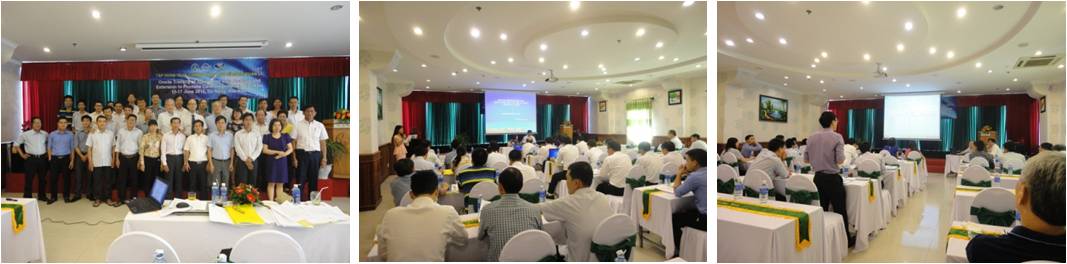
The Training had 3 sessions; session 1. Data collection reporting and analysis, session 2. Utilization collected data for formulation of fisheries resources management plan, and session 3. Practical activity: develop the result to be fisheries management work plan and how to promoted.

The session 1 had five presentations from resource person from Vietnam, Japan (Dr. Tsutom Miyata, the Head of Fisheries Socioeconomics of Japan Fisheries Research and Education Agency, and Mr. Hidenao Watanage) and SEAFDEC (Ms. Thanyalak Suasi, Socioeconomic Scientist). The presentation focus on the overview of data collection in Viet Nam as well as how to collect and analyst the data including reporting the result of data analysis. 

The session 2 composed of five presentations focusing on how to develop the fisheries management plan including the case studies from Japan, Thailand, and the Philippines. It is important to conduct principal/basic survey to get the information for Fisheries Management Plan (FMP). As well as the participation from the fishers is very useful for the data collection and FMP, therefore, it need to encourage and involve the fishers in the process of planning. Moreover, the presentation also clarified more on the supporting from the government which is essential to organize and keep the co-management and CBFM. The government must protect and sustain local fisher's decision and activities for fisheries management by legal framework by giving them the fishery right to protect and sustain CBFM.   

The session 3 was the practical activity: develop the result to be  fisheries management work plan and how to promoted by using law data of Viet Nam. Before start the session, Dr. Yasuhisa Kato, Chief Technical Advisor (CTA) for the Coastal Resource for Sustainable Development Project (CRSD) in Viet Nam, suggested that the officers should understand on the importance of data collection and convince the fishers to collect the data by themselves. Then, Dr. Long kindly presented on the data of Camoa Province. He introduced the CPUE in each month from commune data collected. After that, Dr. Yuttana, who was a chairperson in this session, invited each province to introduce the data and difficulties in order to collect the data. The difficulties were 1) lack of resource person to collect data, 2) the collector have not been trained so they do not collect the data well, 3) fishers use many kind of fishing gears, therefore, it's difficult to identify what each species came from which fishing gear.

After presented all data from the Province, the resources persons kindly gave them the suggestions. The fisheries data should be included the production form illegal fishing gear too even it difficult to get the data. Moreover, if the fishers are very poor, it difficult to change the fishing gear, therefore, the government should support the fishers in order to change the fishing gear. In addition, the participants were very interested on the demarcated community fishing area in Japan. It would very useful, if it can be applied to suit with the Viet Nam condition.

Monitoring at Nam Oon Dam, Sakon Nakhon Province

Date: 22-26 February 2015
Venue: Sakon Nakhon Province

Objectives

1. Monitoring fish catch at before and after close season (16 April - 15 August) by logbook with 16 middleman and 96 fishermen around Nam Oon Dam

2. Preparation of community rule signboard, which contain the close season period, prohibited fishing gear and conservation zone.

Result

SEAFDEC/TD, DOF from Head Quarter and Local Fisheries Officers of Nam Oon Dam organized the meeting and discussion on regulation of closed season for 16 villages around Nam Oon Dam. The meeting organized at four points, one point composed of four villages. The first point composed of Baan Klog Pha Kaew, Baan Don Kam Pho, Baan Na Chuak, and Baan Nong Bua. The second point composed of Baan Na Tan, Baan Na Rao, Baan Hoy Buun, and Baan Nong Phue. The third point composed of Baan Kud Ta Kab, Baan Thai Charoen, Baan Na Kam and Baan Nong Ping. The fourth point composed of Baan Kok Manow, Baan Nong Yah Thium, Baan Klang and Baan Kok Suuk.

There were two main objectives of the meeting; 1) To explain measurement of closed season by using signboard, which would be setup at every village, 2) To select 4-6 volunteer fishermen of each community for catch data recording in logbook, and also select one middleman per one area to record the data. The signboard have four main information (Fig. 1); 1) Map of Nam Oon Dam with location of 16 villages, 2) Name and picture of prohibited fishing gear in whole year, 3) Name and picture of fishing gear which allow for fishing at closed season (16 April-15August), and 4) Name and picture of fishing gear which allow for fishing before and after closed season. For the logbook, it composed of 45 pages, one page composed of type of fishing gear, date, total catch, species and map of Nam Oon Dam (for recording the fishing area). This logbook would be starting record from 1 March to 15 April.

During the meeting, SEAFDEC’s staff also explained the importance of catch data recording, which is necessary for fisheries management plan of Nam Oon Dam. After fished the meeting with 16 villages, there were 64volunteers of fishermen and 4 middlemen for catch data recording. 

The Regional Workshop on Improvement of Fisheries Information Collection in Coastal Small-scale and Inland Fisheries of the Southeast Asian Region


Date: 28-30 January 2013
Venue: Bangkok, Thailand

Objective:
1. Reviewing the problems of fisheries data collection in coastal small-scale and inland fisheries at national; and 
2. Identifying the key issues of fisheries data collection that should be addressed in order to improve the countries’ efforts in fisheries data collection; and
3. Sharing the lessons learned from effective ways of data collection among the SEAFDEC Member Countries.

Background of the Workshop
The Regional Workshop aimed to review and identify the difficulty of fisheries data collection in coastal small-scale and inland fisheries as well as find out the effective ways of data collection from SEAFDEC Member Countries. This could be achieved by fostering the lessons learned in terms of the methodologies and exchanging experiences in effective fisheries data collection. It was also envisaged that such effort could be adapted in the setting up of fisheries census with a future goal of improving fisheries data collection.

In addition, SEAFDEC has fourth stages to support the SEAFDEC Member Countries during 5 years. The first stage is this Regional Workshop. The Second stage is the Regional Training course, which will be organized after this Regional Workshop, on building up the applicable cost effective fisheries information collection scheme for improvement of monitoring to fisheries activities on February, 26 to March, 3 at SEAFDEC-Training Department. The Regional Training course are providing the methodology and knowledge to the participants, then, they will making the idea for future national activities for improvement data collection. After the Regional Training course, SEAFDEC expected that the representatives from SEAFDEC Member Countries in this Regional Training course will making the National Workshop for improvement of fisheries information collection and fisheries statistic for sustainable fisheries management in their own country with supporting by SEAFDEC. The last state, After the National Workshop, SEAFDEC's staff will collaborate with the National's staff to providing the on-site training course to facilitate fisheries information gathering through introduction of community-based fisheries management. SEAFDEC expected that each SEAFDEC member countries will making a plan and take an action in the countries.
Conclusion of the Workshop
The SEAFDEC Member Countries presented their current data collection methods and fisheries information. There are different types of data and information that should be collected and could be used to support management for sustainable fisheries, e.g. census, statistics, survey data, research studies, etc. There are also various tools that could be used to collect data and information such as logbook, questionnaire, survey forms, RRA, PRA. The planning for data collection should consider clear objectives on how the data would be used; and what kind of data is necessary. The data should be able to clarify the fisheries structure, production, species, resources status, and socio-economic status.

The problems and constraints were divided into technical and non-technical problems. For example 1) lack of supervision and training on basic data collection, 2) lack of standardization of fisheries data collection concept, 3) small-scale fishing gears are highly diverse complexity of ecosystem , 4) difficult to get participation from fishermen, and high cost and manpower for data collection. In addition, the countries use top-down (obligation) and bottom-up (voluntary) for data collection method. The top-down (obligation) data collection, which may include official statistics survey form, licensing, registration, documentation, etc. However, the exercise could be much costly than bottom-up approach. The Bottom-up (voluntary) data collection by autonomous community (involving fishers, middlemen, etc.) is considered cost-effective approach. However, efforts need to be undertaken to ensure cooperation and reliability of information, e.g. through enhancing the understanding of the community on fisheries management and importance of data collection to support management. It was also suggested that at the beginning, the bottom-up data collection by autonomous community should be undertaken as pilot project in order to test the effectiveness/reliability of data, before applying the approach nation-wide.

In addition, the questionnaires are one of the tools for data collection that should be focused, simple and clear in order to enable enumerators, autonomous community or fishers to provide information, while also reduce unclear/confusion, e.g. equipped with photographs of fishing grounds (map), fish species identification, etc. Well-designed forms would facilitate the compilation and analysis of the data in order to come up with reliable and meaningful results. Appropriate sample size (extraction number) should be considered to ensure that the collected data could represent the targeted group (population).